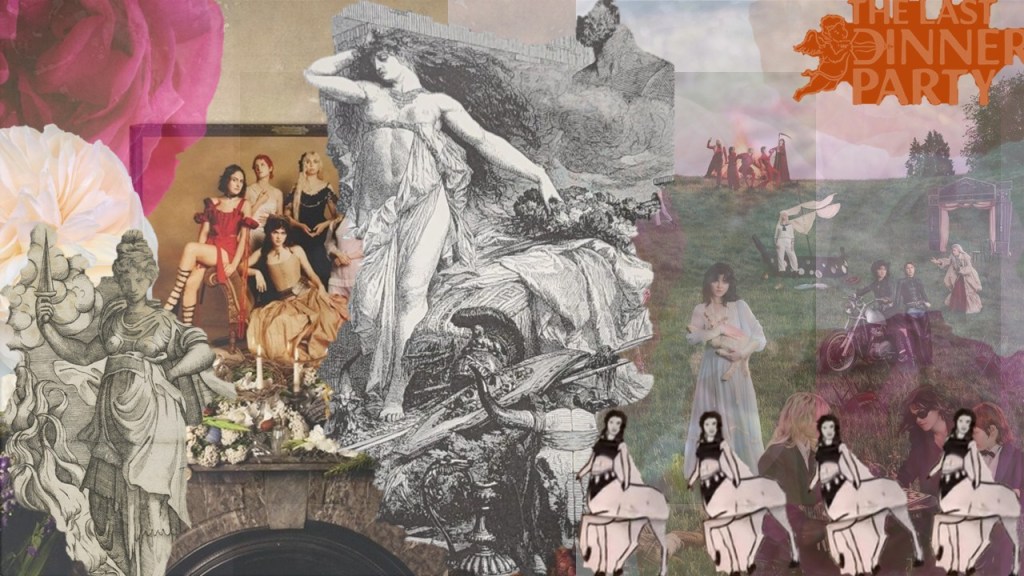
Mythology on the menu: ‘Here Comes the Killer’ video released + From the Pyre announced
In July, The Last Dinner Party (TLDP) released ‘This is the Killer Speaking’. The first single and fourth track on their upcoming album, From the Pyre (out October 17th 2025).
Announcing the album, TLDP said: “This record is a collection of stories, and the concept of album-as-mythos binds them. ‘The Pyre’ itself is an allegorical place in which these tales originate, a place of violence and destruction but also regeneration, passion and light.”
In other promotional material, they have promised “a myth weaved from the torn edges of real experiences; we cast ourself as saints and cowboys, lovers and sailors, angels and mothers and players.”

Watching TLDP’s recent This is the Killer Speaking video, which sees the metamorphosis of Emily Roberts (guitarist) into ‘The Soho Centaur’, I think, come October, we may well be in for a pop-classical treat…
But before the release of From the Pyre, I want to write to you about TLDP’s debut album. So, without further ado, I present to you…
Prelude to Ecstasy – A Pop Classical Reading – Part One
Prelude to Ecstasy was one of my most-listened-to albums of 2024. I think it is exceptional, both musically and in its storytelling. And when I saw TLDP at Glastonbury (June ’24) and Hammersmith Apollo (October ’24) last year, they did not disappoint. Ever since, I have meant to write about the plethora of references and resonances to the ancient world that I have found in their music. I did so, in part, in my article exploring twenty-first-century social media leaders and their relationship(s) to Caesar. Read here:
But now, I want to explore this fantastic album in full, suggesting, how we might read their music in conversation with myth-history. In particular, I want to highlight how TLDP allude to the ancient world in their explorations of power, gender, and queerness.
Below is Part One of my reading, which features ‘Prelude to Ecstasy’ and ‘Burn Alive’.
I’ll return to talk about ‘Caesar on a TV Screen’, and ‘The Feminine Urge’ in Part Two (coming soon). And ‘On Your Side’, ‘Beautiful Boy’, ‘Gjuha’, ‘Sinner’, ‘My Lady of Mercy’, ‘Nothing Matters’, and ‘Mirror’ in Part Three (again, coming soon).
(i) Prelude to Ecstasy: a proem?
The first song, the eponymous ‘Prelude To Ecstasy’, is solely instrumental. It features a breadth of instruments, many orchestral. It was composed by TLDP’s keyboardist, Aurora Nishevci, and was described by Abigail Morris (lead singer) as an “overture”, containing themes from the tracks that will follow.
There is something decidedly epic about this opening. Much like Homer signifies the themes of the Iliad and Odyssey with their first lines, musically, this track sets out the story and tenets of the album to come.
To my ear, ‘Prelude to Ecstasy’ is a statement, a promise, which invites the listener in.
It is confident about what is to come.
It opens itself up for analysis.
(ii) Burn Alive: an anthem for Dido?
With this prelude complete and the album’s themes introduced, ‘Burn Alive’ begins.
And I must say, as a frequent teacher of the OCR Classical Civilisation A-Level World of the Hero paper, I am quite enamoured with the idea of this song being/becoming an anthem for Dido. Here’s my pitch:
For those unfamiliar with her story, Dido is the Carthaginian host/lover of Aeneas (the Trojan soldier/soon-to-be-founder-of Rome) in Virgil’s Aeneid.
Here’s a very brief summary:
Aeneas is a Trojan, fleeing his home which has been destroyed by the Greeks (post Trojan Horse). A storm hits and sends him and his comrades off course to Carthage, a prosperous city ruled by a powerful queen, Dido. Dido plays host to Aeneas and the Trojans. The gods meanwhile are, as usual, at arms, and quickly interfere with the situation developing on Carthage. Specifically, a whirlwind affair between Dido and Aeneas is strongly encouraged by Juno. Only to be counteracted by Jupiter, who sees it as imperative that Aeneas reaches Rome as soon as possible, and via his messenger Mercury instructs Aeneas to leave his newfound love, Dido, behind. When Aeneas announces his subsequent decision to depart, Dido is so angered and bereft that she curses Aeneas/Rome, before committing suicide, having climbed the pyre she had built for this moment. And sailing away, Aeneas sees the flames in the distance, not realising(/caring?) what has become of the lover he left behind (until they meet again in the Underworld in Book 6).
If we take the song unit by unit, reading the lyrics of its opening verse and chorus alongside lines from Virgil’s Aeneid, the story told is not a dissimilar one…
‘Burn Alive’ and the Aeneid side-by-SIDE ANALYSIS
Here are the lyrics of ‘Burn Alive’ verse one:
Wine is on your blouse / You think it’s so romantic / But in reality / We’re both just addicts.
Now, compare the ‘wine’ of ‘Burn Alive’ to the banquet between the Carthaginians and Trojans. They share a decadence, an atmosphere.
The banquet (Book 1)
At the first lull in the feasting, the tables were cleared, / and they set out vast bowls, and wreathed the wine with garlands. / Noise filled the palace, and voices rolled out / across the wide halls: / bright lamps hung from the golden ceilings, / and blazing candles dispelled the night. / Then the queen asked for a drinking-cup, heavy / with / gold and jewels, that Belus and all Belus’s line / were accustomed to use, and filled it / with wine.
(A.S. Kline (2002), courtesy of Poetry in Translation)
Next, consider the line ‘you think it’s so romantic’ alongside the love that blooms between Dido and Aeneas after the dinner they share together. They stain each other’s thoughts.
‘Romantic’ tidbits (Book 4)
now [Dido] longs for the banquet again as day wanes, / yearning madly to hear about the Trojan adventures once more … Absent she hears him absent, sees him …
Aeneas has come, born of Trojan blood, a man whom / lovely Dido deigns to unite with: now they’re spending / the whole winter together in indulgence, forgetting / their royalty, trapped by shameless passion.
(A.S. Kline (2002), courtesy of Poetry in Translation)
The verse’s closing lyrics disrupt this story: ‘but in reality, / we’re both just addicts‘. Just as the reality that Dido and Aeneas are not truly in love but have been tricked/tempted into their affair by the gods undercuts their tale in the Aeneid.
Cupid deceives Dido, making her fall in love with Aeneas (Book 1)
Dido, clings to him [Cupid] with her eyes, / and with her heart, taking him now and then on her lap, /unaware how great a god is entering her, to her sorrow. / But [Cupid], remembering [Aphrodite’s] wishes, / begins gradually to erase all thought of Sychaeus, / and works at seducing her mind, so long unstirred, / and her heart unused to love, with living passion.
(A.S. Kline (2002), courtesy of Poetry in Translation)
Juno plots to disrupt Aeneas and Dido’s hunting trip, compelling them to take shelter in each other’s arms… (Book 4)
Now listen and I’ll tell you briefly / how the purpose at hand can be achieved. / Aeneas and poor Dido plan to go hunting together / in the woods, when the sun first shows tomorrow’s / dawn, and reveals the world in his rays. / While the lines are beating, and closing the thickets with nets, / I’ll pour down dark rain mixed with hail from the sky, / and rouse the whole heavens with my thunder. / They’ll scatter, and be lost in the dark of night: / Dido and the Trojan leader will reach the same cave. / I’ll be there, and if I’m assured of your good will, / I’ll join them firmly in marriage, and speak for her as his own: / this will be their wedding-night.
(A.S. Kline (2002), courtesy of Poetry in Translation)

And a pattern/an arc emerges:
(i) decadence >> (ii) presumed love >> (iii) addiction/deception.
OR (i) circumstance >> (ii) fantasy >> (iii) reality.
But what is the consequence of such reality/addiction?
***

Here’s the ‘Burn Alive’ chorus:
I am not the girl I set out to be / Let me make my grief a commodity / Do what I can to survive / There is candle wax melting in my veins / So I keep myself standing in your flames / Burn, burn me alive
Where, the song title – altered slightly in the chorus (‘burn me alive’) – offers the most obvious parallel between the stories told by TLDP and Virgil: a woman, deceived by or addicted to love, submits herself to flames. But a closer look at the lyrics of the chorus adds considerable texture to the comparison.
Set the line ‘I am not the girl I set out to be’ alongside the supremacy of Dido documented in Book 1 of the Aeneid.
Descriptions of Dido and Carthage (Book 1)
Dido’s prosperous settlement
The eager Tyrians are busy, some building walls, / and raising the citadel, rolling up stones by hand, / some choosing the site for a house, and marking a furrow: / they make magistrates and laws, and a sacred senate: / here some are digging a harbour: others lay down / the deep foundations of a theatre, and carve huge columns / from the cliff, tall adornments for the future stage. / Just as bees in early summer carry out their tasks / among the flowery fields, in the sun, when they lead out / the adolescent young of their race, or cram the cells /with liquid honey, and swell them with sweet nectar, / or receive the incoming burdens, or forming lines / drive the lazy herd of drones from their hives: / the work glows, and the fragrant honey’s sweet with thyme.
Dido’s power and beauty
Queen Dido, of loveliest form, reached the temple, / with a great crowd of youths accompanying her. / Just as Diana leads her dancing throng on Eurotas’s banks, / or along the ridges of Cynthus, and, following her, / a thousand mountain-nymphs gather on either side: / and she carries a quiver on her shoulder, and overtops / all the other goddesses as she walks: and delight / seizes her mother Latona’s silent heart: / such was Dido, so she carried herself, joyfully, / amongst them, furthering the work, and her rising kingdom.
(A.S. Kline (2002), courtesy of Poetry in Translation)
….
Now imagine these words in Dido’s mouth and you have a sense of Dido’s impending tragedy. She is not the queen she ‘set out to be’. She has forsaken her kingdom for love. She has betrayed herself, her ambition.
Next, our imaginary Dido says: ‘Let me make my grief a commodity’, offering two interesting interpretations of Dido’s tale…
(i) In Book 4, Dido curses Aeneas and the Romans before taking her own life. And in exchange for her death, she is rewarded with the future suffering of the Romans (the Punic Wars). This way, her grieving for the departed Aeneas is ‘commodified’.
Dido’s curse (Book 4)
O Sun, you who illuminate all the works of this world, / and you Juno, interpreter and knower of all my pain, / and Hecate howled to, in cities, at midnight crossroads, / you, avenging Furies, and you, gods of dying Elissa, / acknowledge this, direct your righteous will to my troubles, / and hear my prayer. If it must be that the accursed one / should reach the harbour, and sail to the shore: / if Jove’s destiny for him requires it, there his goal: / still, troubled in war by the armies of a proud race, / exiled from his territories, torn from Iulus’s embrace, / let him beg help, and watch the shameful death of his people: / then, when he has surrendered, to a peace without justice, / may he not enjoy his kingdom or the days he longed for, / but let him die before his time, and lie unburied on the sand. / This I pray, these last words I pour out with my blood. / Then, O Tyrians, pursue my hatred against his whole line / and the race to come, and offer it as a tribute to my ashes. / Let there be no love or treaties between our peoples. / Rise, some unknown avenger, from my dust, who will pursue / the Trojan colonists with fire and sword, now, or in time / to come, whenever the strength is granted him. / I pray that shore be opposed to shore, water to wave, /weapon to weapon: let them fight, them and their descendants.
(A.S. Kline (2002), courtesy of Poetry in Translation)
And (ii) the idea that Dido is defined by her grief, and it is this that gives her a legacy. Meta-textually, she profits from her tragedy, just as, perhaps, drawing from her pain, Morris prospers as a lyricist/songwriter/artist. (I’ll return to this later!)
Finally, compare the line So I keep myself standing in your flames to the imagery deployed by Virgil, with fire connoting love/lust:
‘Flames’ in the Aeneid
… arouse the passionate queen / by his gifts, and entwine the fire in her bones (Book 1) …
… you’ll breathe hidden fire into her, deceive her with your poison (Book 1) …
… The unfortunate Phoenician above all, doomed to future ruin, / cannot pacify her feelings, and catches fire with gazing (Book 1) …
***
But the queen, wounded long since by intense love, / feeds the hurt with her life-blood, weakened by hidden fire. (Book 4)
AN ANTHEM FOR DIDO: THE IMPLICATIONS?
Whilst this side-by-side analysis of TLDP’s lyrics and Virgil’s poetry is, no doubt, an enjoyable exercise and has perhaps convinced you of the validity of a comparison between ‘Burn Alive’ and the Aeneid, now I want to dig deeper as to how such an analysis might affect our understanding of these works…
How does knowing Dido’s story impact how we listen/connect to ‘Burn Alive’ as a song? And comparing ‘Burn Alive’ to the Aeneid, how is our image/notion of Dido affected?
For those new to ancient world studies, these questions are at the heart of what we might term classical reception.
A definition of classical reception
‘the ways in which Greek and Roman material has been transmitted, translated, excerpted, interpreted, rewritten, re-imagined and represented.’ (Hardwick and Stray, A Companion to Classical Receptions, p.1)
To do this, having established the similarities between the Aeneid and ‘Burn Alive’, we must progress to explore their points of difference.
Some scholars have argued that Virgil’s telling of Dido’s story is highly sympathetic and she is, perhaps even, a tragic heroine of the Aeneid. And while Virgil dedicates time to her death, giving Dido space that other poets might not afford, ultimately, we experience her story – and its tragedies – from Aeneas’ perspective. In Book 5, it is Aeneas who watches the smoke rise from Carthage, unknowing of the fact that it is his former lover at the pyre. In Book 6, it is Aeneas who will attempt to speak to Dido in the Underworld in vain. Aeneas’ loss is centred. Dido is collateral damage, one of many that Aeneas will lose on his mission to found Rome – her tragedy subsumed into his destiny. Arguably, it ennobles him. He forsakes amor (love) for Roma (Rome).
Comparatively, if we see ‘Burn Alive’ as a song for Dido, it is her perspective that is championed. And integral to this is the lyric/refrain from which the track derives its title:
Burn, burn me alive.
Imbued in Morris’ performance of these lyrics and the music that accompanies them (a voluminous shimmering synthesis of instruments), especially in the song’s climactic outro, is a sense of power, revelry and desire.
‘Burn Alive’ is the subversion / reclamation of the age-old trope of the woman scorned/scorched.
Through ‘Burn Alive’, they choose a male-centred narrative and tip it on its head. Burning is sexy. Burning is feminist. Burning is a choice.
If we regard this is as a song for Dido, her fate is no longer tragic, but tantalising.
BURN ALIVE – WHAT DOES THIS SONG ‘SET OUT TO BE’?
So far, so good, but I want to take my our interpretation of ‘Burn Alive’ one step further. Now is the right time, I feel, to introduce TLDP’s perspective on their song. In the track notes section of Apple Music, Morris writes the following of ‘Burn Alive’:
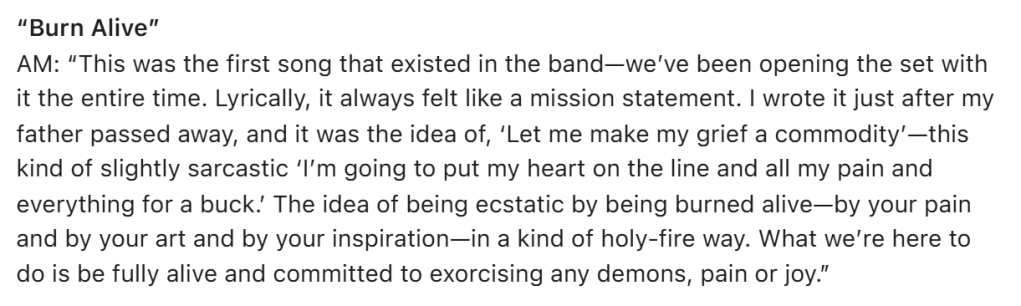
How does the TLDP ‘mission statement’ align with the relationship I have observed between ‘Burn Alive’ and Dido’s story? Does it support the interpretation I’ve put forward?
To answer this, I want to ask the following. Regardless of whether Dido provided any inspiration in TLDP’s creation of this song…
Why subvert/reclaim the story/arc of the burning woman? What purpose does this serve?
And, to me, two reasons in particular stand out:
(i) To explore the relationship between pain and pleasure.
In the second verse of ‘Burn Alive’, Morris sings the following:
You don’t want to hurt me / But I want you to
And we have a progression of the association between fire/burning and romance (‘so I keep myself standing in your flames‘) set out in the chorus. Indeed, TLDP forges an explicit lyrical relationship between PLEASURE and PAIN. Or, as Morris puts it, ‘the idea of being ecstatic by being burned alive’.
The easy/ready interpretation of the ‘you don’t want to hurt me / But I want you to’ lyric might be to says that female burning is deployed by TLDP as a shorthand for pleasure or a nod to sadomasochistic sexual preference, which it may well be (TLDP do not shy away from sex in their song-making). I think there is more to be drawn from these lyrics than that. To support this argument, let’s return to Dido’s story momentarily…
Imagine the words ‘You don’t want to hurt me / but I want you to’ in Dido’s mouth and her death takes on a whole new meaning. It is no longer a tale of tragedy, but personal gratification. Her death becomes a transgression, a form of revenge upon Aeneas, who does ‘not want to hurt’ her. Her death is a choice and Aeneas will suffer the consequences for years to come. (Interestingly, if we recall the curse that Dido sets upon Aeneas (and how the Romans will subsequently suffer at the hands of the Carthaginians in the Punic Wars), this imagining/interpretation of Dido’s character that TLDP’s ‘Burn Alive’ opens us up to is not so far from Virgil’s original text.)
Read through this lens, in the relationship between pain and pleasure that TLDP sets out, there exists agency, empowerment, and subversion.
***
(ii) To explore the artistic/creative/commercial legacy of pain/grief.
Going further, though, I think we need not only to consider the relationship between pain and pleasure in ‘Burn Alive’ but pain and profit, as introduced in the chorus (‘let me make my grief a commodity‘), and how this relationship is progressed in the song.
Let’s consider the closing lines of verse two:
I’d break off my rib / to make another you
The reference to the creation of Eve from Adam’s rib (Genesis 2:22) is especially important given the context in which this song was written: ‘just after [Morris’] father passed away’. The image conjured of the volunteered rib, which proposes self-sacrifice/injury in order to facilitate resurrection (‘another you’), is perhaps the most mournful lyric of the entire song. Read in light of her loss? It suggests that Morris would give/suffer anything to have her father back.
But what place does such a sentiment have in a pop/rock song? Here Morris’ comments are of critical importance. The song, she says, is written to be ‘slightly sarcastic’. She is conscious of the fact she is putting her ‘heart on the line’ … ‘for a buck’.
Morris’ pain profits her. The stakes here are not only lyrical, but commercial/financial.
Is this a concession to or a rebellion against the demands of the music industry? This is an open question.
Does Morris, like Dido, submit herself to the flames, knowing that she cannot fight the fate/system decreed by those above? Or does she offer a solution to the hundreds and thousands of grieving women who have suffered before her: commodification = reclamation/reparation? (Would Morris urge Dido, if she could, to tell/sell her story, instead of being an episode in Aeneas’ one?)
Whatever our conclusion, Morris sets the trend here for a meta-textuality/theatricality that will continue to permeate the album (e.g., ‘Caesar on a TV Screen’ refrain ‘I’m only here for your entertainment’). And, whether we see ‘Burn Alive’ as a submission or subversion of the expectations of fame, I would argue that self-awareness is a source of both power and success for TLDP. Acknowledging the traditions in which they participate, as lovers/mourners/musicians, they acquire a seat at the negotiating table to perhaps redefine/expand/invest in those traditions, should they wish.
CODA: NOT DIDO, BUT A ‘SINNER’?
While queerness is not an overt theme in ‘Burn Alive’, it is omnipresent in TLDP’s music-making, and it is an area I wish to highlight in brief, before I continue my exploration of this album in Prelude to Ecstasy – A Pop Classical Reading Parts Two and Three.
To do so, I want to examine the lyrics of the pre-chorus that come towards the end of the song:
You made me bite my tongue / Now there’s blood in my glass
Before I get into my analysis, I want to admire the sheer poetry at play here, the way this line picks up on the very opening lyric of ‘Burn Alive’ (‘Wine is on your blouse’). The idea of spillage, ruin, decadence, a dinner party gone wrong. I love also how it wrongfoots the listener. How the ‘blood in my glass’ is the principal concern (as opposed to ‘blood in my mouth’ or ‘glass in my mouth’ or another lyrical iteration). The focus is not the injury, the bodily harm, but the glass of wine, spoiled by this blood/incident. Allusive and elusive.
Beautiful line. But what is its meaning/effect? The simplest interpretation, I think, would be I censored myself and this caused me harm. Holding back, I spoiled the wine/the fun. Applied to the story of Dido, it would be a call to express oneself, without reservation. A message of female empowerment.
But perhaps more significantly, we might also interpret the ‘blood in my glass’ as a reference to the taking of the Eucharist (the idea that in the Catholic faith, in which Morris was educated, by drinking wine you drink the blood of Christ).
Quick thought experiment for you: imagine we substitute the word ‘now’ for ‘because’ (as opposed to taking it to mean ‘and so’, or ‘therefore’).
‘you make me bite my tongue / [because] there’s blood in my glass’
And this line becomes not only about the consequences of self-censorship, but the cause/context/conditions for such an act to take place. In this case, how the religion that surrounded Morris as a child was at odds with her queerness. An incongruity that is explicitly addressed in TLDP’s eighth track, ‘Sinner’.
I asked earlier, why subvert/reclaim the story/arc of the burning woman? Let us reconsider Morris’ explanation: ‘What we’re here to do is be fully alive and committed to exorcising any demons, pain or joy.’ Is the burning a metaphor for the pains and pleasures of queerness? Does the song resist heteronormativity? Is its message that you do not have to the girl you set out to be (were educated/raised/told to be)?
While I love the idea that ‘Burn Alive’ is an anthem to/for Dido and have argued strongly in favour of this interpretation, it’s perhaps more likely that this song is not rooted in classical myth-history at all, but the punishment of those who defied traditional Christian norms. Recall the lyrics inspired by Genesis (‘break off my rib’) or the opening lines of the second verse: ‘I am at the stake / petrol my perfume‘. And we may feel more compelled to regard this as a reference to the executions of Joan of Arc OR Anne Askew OR the historical practice of burning of witches. Or any other woman, for that matter, executed for her sins/misdeeds…
But whomever we imagine to be burning when we listen to this song, the overriding principle is, I think, much the same. TLDP takes the scorned/scorched woman – be her Dido or another – and makes her lustful, powerful, desirous. Not only this, but they make her human (‘fully alive’). She has wants, she has worries, she has wine on her blouse. She is more than has/will become of her. And this fullness sets the tone for the album to come.
 The Pop Classicist
Leave a comment