The Phryges and the Phrygian Cap: An Introduction
Watch this video and you’ll see it opens with a painting: La Liberté guidant le peuple (Liberty leading the People) by Eugene Delacroix. A commemoration of the French Revolution of July 1830, the overthrowing of Charles X.
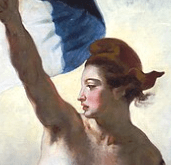
Specifically, the video zooms into the head covering sported by Liberty. A Phrygian cap. It is this red hat that provides the visual inspiration for the mascots of the Paris Games, The Phryges.
The Phrygian Cap as Symbol: A History
Explaining its choice to transform the Phrygian cap into the Olympic and Paralympic mascot, the Paris 2024 website writes the following:
A symbol of revolution, the French Republic and freedom, the Phrygian cap can be seen on French national icon Marianne, depicted in busts at town halls across the country and on stamps, and is also covered in the national curriculum in schools.
The Phryges follow a long lineage, as the Phrygian cap was part of all the major events in French history. The French National Archives show records of Phrygian caps worn during the construction of Paris’ Notre-Dame cathedral in 1163, during the Revolution of 1789, during work to build the Eiffel Tower, and during the Paris 1924 Olympic Games.
Read more here!
The cap, it says, is key to its national story and identity: a marker of revolution, republic, and freedom. Notably, France is not the only country to adopt the headwear as a symbol of freedom. The red cap is also found on the Seal of the US Senate, accompanied by the word ‘Liberty’.

Read an exploration of its meaning in American politics and its inclusion in imagery across the US Capitol here: https://www.aoc.gov/explore-capitol-campus/blog/liberty-cap-symbol-american-freedom.
Footnote: We find other classical references, e.g. the Latin motto ‘E pluribus unum’ (one from many) and the Roman fasces (bundles of rods with an axe) at the foot of the seal, on the US Senate seal. The intersection between modern American politics and the classical world is a rich and fascinating topic, which I hope to explore further in future blogposts. Especially, perhaps, in the lead up to the November 2024 Presidential Election.
The Phrygian Cap: A Pop Classical Point of Interest
If, during the course of reading this blogpost, you have looked at the cap and it’s reminded you of the Smurfs, specifically Papa Smurf, you would not be mistaken! The Belgian comic artist, Peyo, was thought to have been inspired by the Phrygian cap when choosing an accessory for his characters. Specifically, a red cap for Papa Smurf, and white caps for his Smurf friends and followers.

I wonder if the Paris 2024 designers had considered the link between their own mascots and Peyo’s twentieth century creations. Was this an deliberate choice/visual association, or a pop-classical accident?

Ancient Imagery and the Parisian Use of the Phrygian Cap: A Pop Classical Irony
The Phrygian cap, as adopted as a mascot by the Paris Olympics, is one of a variety of soft, conical hats found in the ancient world associated with peoples and cultures east of Greece.
But where was Phrygia? Who were the Phrygians? And what was the significance of their headwear?
Phrygia is an ancient kingdom located the centre of modern Turkey. If you want to learn more, a summary of the region and its history can be found here: https://www.worldhistory.org/phrygia/. Today, I’ll be focussing on representations of its people (and their caps) in Greco-Roman literary and visual imagination.

In Homer’s Iliad, Hecuba, queen of Troy, is the daughter of a Phrygian king (Dymas). And the Phrygians are allies of the Trojan people, helping them in their war efforts against the Greeks.
In Greco-Roman art, the Phrygian cap is often deployed to depict Trojan/Eastern figures: a visual marker of otherness/non-Greekness.
See here a bust depicting either Attis (consort of the Anatolian goddess, Cybele), or Ganymede (brother of the founder of the city of Troy and a mythic ancestor of the Trojan hero Aeneas)!

Or here, a statue of the Trojan prince Paris, who, permitted by Aphrodite, takes Helen – daughter of Zeus and wife of Menelaus – from Sparta, sparking the Trojan War!

Both don the cloth hat! As do many other classical depictions of the Trojans and their associates, which I unfortunately lack the expertise and time to catalogue for you in this blogpost.
Instead, let me ask you, reader…
Do you see an irony emerging?
If you don’t yet, don’t worry. It’s super fun! Let’s explore it together…
Okay, so, the Ancient Greeks are the famous founders of the Olympics, right?
And then, the Trojans are one of the most famous enemies of the Greeks.
Considering this, isn’t it kind of amazing/amusing/awesome that two millennia later, in 2024… the Paris game-makers have chosen one of the famous visual symbols of the Trojans (the famous enemies of the mythic Greeks) as a mascot for their Olympics (synonymous with and famously founded by the ancient Greeks)?
***
To compare this ancient/modern Olympian irony to a scenario in football would be perhaps to liken it to ex-Tottenham captain Harry Kane receiving a trophy in the shape of a cannon (the emblem of Arsenal) for his goalscoring efforts in the Bundesliga. A possibility that caused football fans much hilarity earlier this season! [1]


This compelling and potent Olympian irony, of course, raises a lot of questions, which I will continue to think upon over the coming month as I watch the Olympic and Paralympic games unfold, including but not limited to:
- How does the use of the red cap on Delacroix’s painting, to the US Senate Seal, to the Smurfs impact our modern understanding and interpretation of the ancient world? And vice versa?
- What does it mean to use an ancient symbol of non-Greekness for a Greek-founded sporting competition? Might we consider it an act of subversion, reclamation, or liberation of the games?
- Do you think this was intentional on the part of the Paris game-makers? Or a(n) (un)happy coincidence?
What do you think?
As always, I would love to hear your ideas in the comments below! And I look forward to exploring further pop classical questions in my future blogposts, as well as my planned PhD research.
If you enjoyed reading this, please check out my other work, share this post, and subscribe to my blog below! Gratias tibi ago – The Pop Classicist
 The Pop Classicist
Leave a comment