Intro: The Gladiator II Trailer
Yesterday, the official trailer for Gladiator II was released. In 24 hours, it has racked up over 11.7 million views on YouTube. To say I am excited about the film, and its potential bearings on my research, is an understatement.
But my sense of anticipation only increased when I heard the song that came in at 1:59 and continued to play until the advert’s end. It was none other than JAY-Z and Kanye West’s ‘No Church in the Wild’ (ft. Frank Ocean & The-Dream), the opening track of their 2011 album, Watch The Throne.
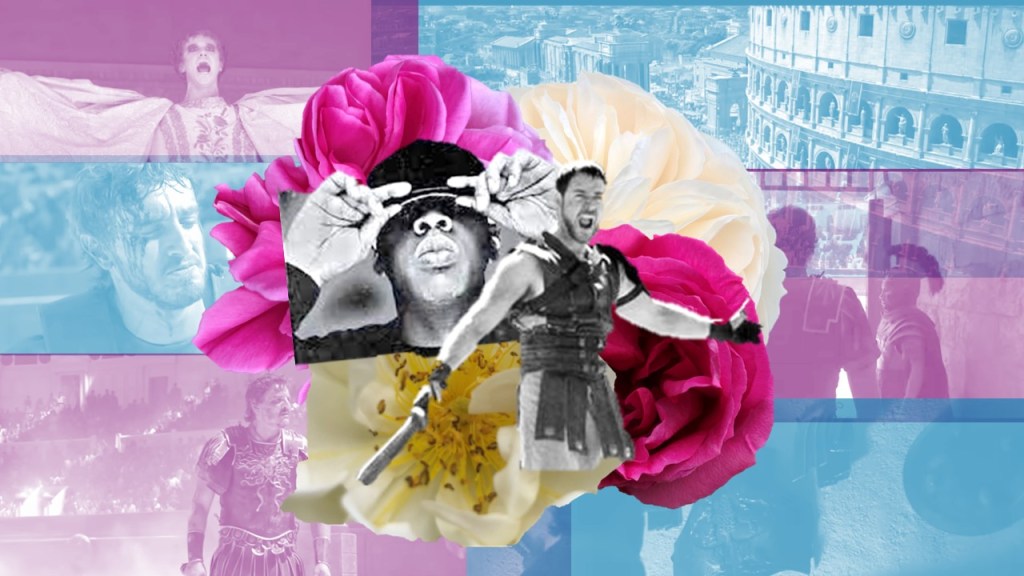
The visual and thematic parallels between this music video and the Gladiator II trailer alone are fascinating – revolution, fire, ire, classical sculpture, corruption, the wild – and I’m sure I’ll explore them in a future blog post. For now, however, I wish to focus upon the impact/prescience/implications of the choice of ‘No Church in the Wild’ to provide the soundtrack for a film about the Roman empire and its infamous gladiatorial games.
The Ancient World, Gladiator II & ‘No Church in the Wild’
Some Questions
Asked by Macrinus (Denzel Washington) whose head will satisfy his fury, Lucius (Paul Mescal) responds: ‘The entire Roman army’s’, but ‘the general will do’. It is after Lucius speaks these words that the music begins. Specifically, the opening of the song/the first lines of Frank Ocean’s chorus…
Human beings in a mob / What’s a mob to a king?
The lines speak to a struggle that will be essential to the film and much broader cultural narratives and histories of Ancient Rome: the fight between the mob/the people and the emperors/generals/those in power.


Ocean’s chorus is then chopped up. Omitting the lyrics about gods and non-believers (which will be deployed later in the trailer), the next lines we hear are:
Will he make it out alive? / Alright, alright
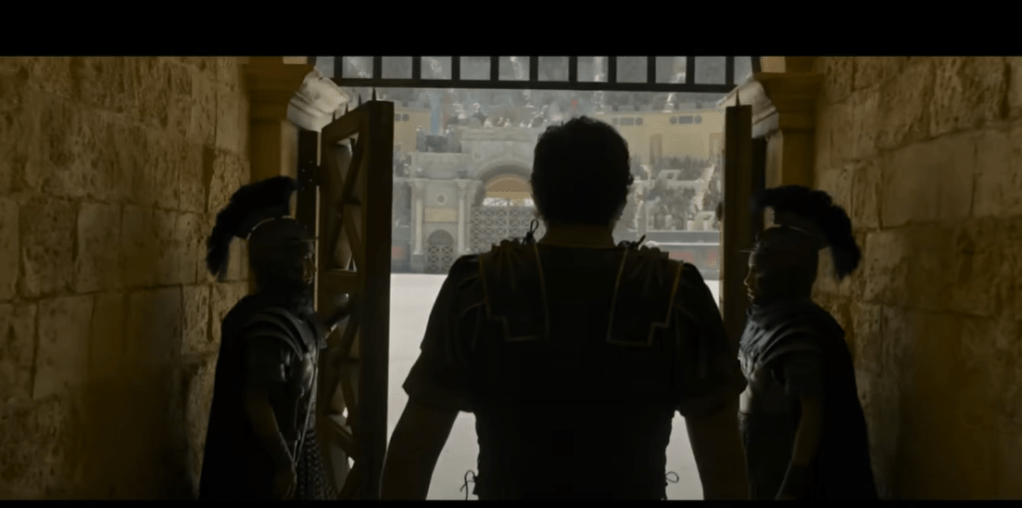
These words provide the soundscape for Marcus’ (Pedro Pascal’s) entry into the colosseum. The question asked by the deployment of this sampling is simple but effective: will Marcus survive the upcoming fight? What is the risk that every gladiator who steps into an arena takes?
***
It is after this refrain that JAY-Z’s rap begins…
Tears on the mausoleum floor / Blood stains the Colosseum doors
The Gladiator II trailer echoes these lines (“blood stains”, “blood stains”) to powerful effect as it reaches its visual and sonic crescendo: Marcus’ combat; Lucius’ (Mescal’s) interaction with Maximus’ ring and armour; the eventual meeting of these enemy combatants in the arena.

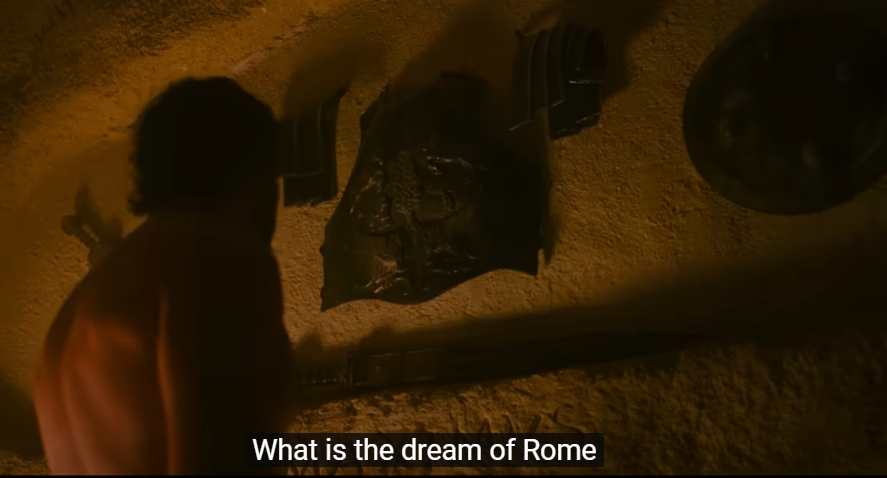
JAY-Z’s lyrics, of course, provide a perfect literal accompaniment to the video footage (words/music about blood, death, tears, and colosseums meets images of blood, death, tears, and colosseums), and perhaps an answer to Ocean’s question. Massacre and mourning await. But thematically, there’s also a lot at stake.
The very title of the song ‘No Church in the Wild‘ might be said to set culture and nature in opposition, or at the very least, call into question the power that cultural institutions/spaces, such as churches, hold.
It is compelling, then, that JAY-Z opens his rap with references to mausoleums (funerary monuments) and colosseums (amphitheatres), the sites that made spectacles of death in the ancient world.
For a pop classicist like myself, it sparks so many questions, the likes of which I strive to explore during a PhD…
- What is the social/cultural value of ancient spaces like colosseums, which have made spectacles of violence?
- What is the relationship between a Roman colosseum and a Christian church? Why lyrically/musically forge this link?
- What does the ancient world mean to JAY-Z? Why rap about a colosseum?
- How does a cultural knowledge of, or interest in Ancient Rome impact JAY-Z as a lyricist, musician, and performer?
- In turn, how do JAY-Z’s lyrics about ancient Rome and their inclusion in a trailer for a film about gladiators change/facilitate/impact modern engagements with and understanding of the classical?
***
Some Answers (More Questions!)
During the trailer’s closing sequence, the lines omitted from Ocean’s chorus are deployed, spliced with JAY-Z’s words…
What’s a mob to a king?
What’s a king to a God?
What’s a God to a non-believer?
Lyrically, this tricolon of rhetorical questions posed is fascinating in and of itself, but especially when applied to an analysis of the Gladiator II trailer.
The logic/the driving force of Ocean’s chorus is as follows… Sure, a king is more powerful than a mob. And sure, a god is more powerful than a king. But, listen up, a non-believer (one of the mob) is more powerful than any god or king.
To express it algebraically… A < B. B < C. What if A > C?
It is not the people (and who/what they chose to believe in) that truly hold the power?
Consider, then, the impact of this musical message on the final piece of dialogue in the Gladiator II trailer. The emperor’s declaration: ‘The gods have spoken’.
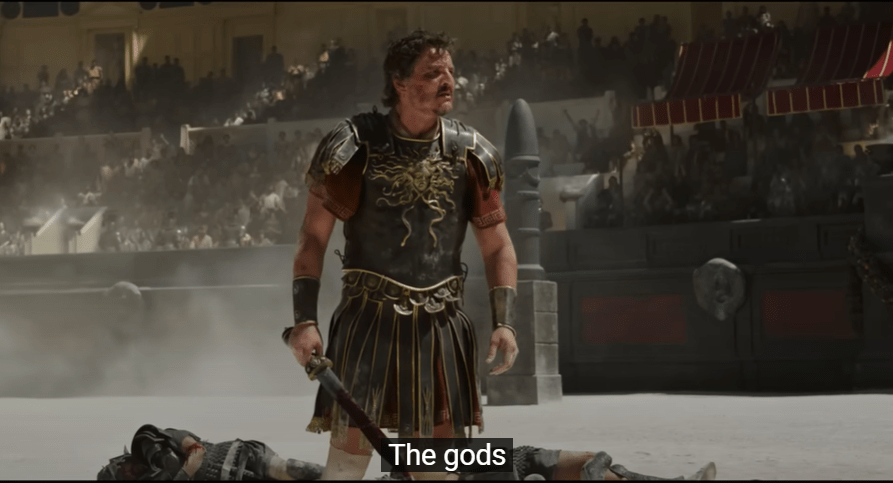

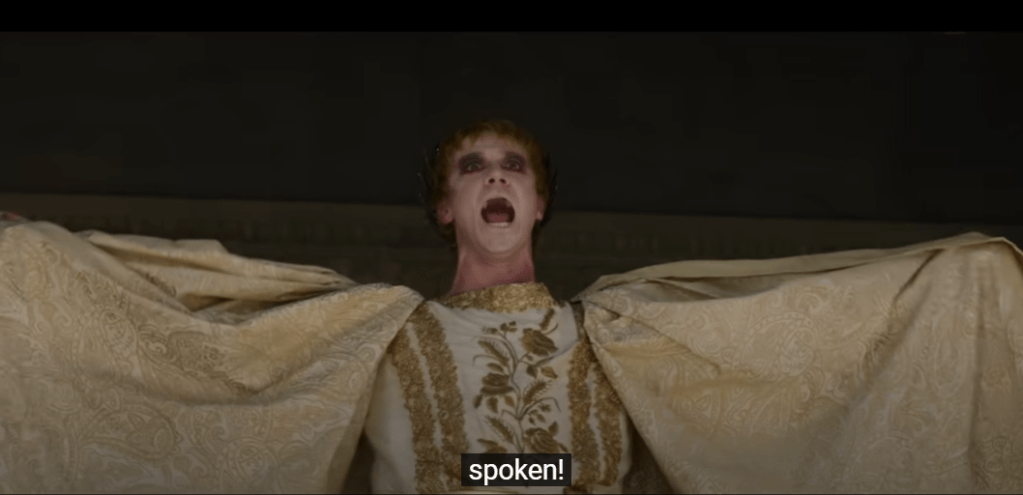
The emperor (king) may have spoken. And he may say that the gods (his gods) have spoken. But what will Lucius, the gladiator (the non-believer, the man of the mob), say in response?
Posed this question, by Ridley Scott/by Frank Ocean/by JAY-Z, we, the people, are invited to see Gladiator II in November. To discover Lucius’ answer. But, perhaps also, and more powerfully, to form our own response… watching a story about the ancient world, we are prompted to interrogate our modern one…
Who are our kings?
Who are our gods?
Do/should we believe in them?
‘No Church in the Wild’: A Footnote
Significantly, JAY-Z not only makes reference to Ancient Rome in ‘No Church in the Wild’, but also Ancient Greece. Later in his verse, he raps…
Is Pius pious ’cause God loves pious?
Socrates asked whose bias do y’all seek?
All for Plato, screech
This sophisticated reference to the Euthyphro – a Platonic dialogue exploring the meaning of piety and justice – is brilliantly explored by Professor Dan-el Padilla Peralta in The Classics in/of Hip-Hop…
https://eidolon.pub/from-damocles-to-socrates-fbda6e685c26
An absolute must-read! I encountered this article when I was a teenager and it has inspired me and my research ever since.
And while these particular lyrics are not included in the Gladiator II trailer, they are a noteworthy presence in ‘No Church in the Wild’ and, undoubtedly, impact our analysis of the relationship between this song, the advert, and the ancient world.
I myself am no philosopher. But the premise of the Platonic dilemma/the question that JAY-Z asks with the lyric ‘Is Pius pious ’cause God loves pious?’ is as follows:
- Do gods love good actions because they are inherently/objectively/unquestionably good?
- Or, are actions good because they are loved by the gods?
To give a gladiatorial example…
- E.g., The majority would agree that for one human to kill another is a ‘bad’ (not ‘good’) action, right? (‘Thou shalt not kill’ is a moral and ethical imperative that underpins many and various ancient and modern cultures, religions and societies.)
- But if Gladiator A kills Gladiator B in the arena because ‘the gods have spoken’, does A’s murder of B become ‘good’ because it is committed in the name of the ‘gods’, or the ‘gods’ command it/watch on?
According with Socrates, JAY-Z suggests – just like in the ‘No Church in the Wild’ chorus and the Gladiator II trailer- the answer must be…
It depends what you choose to believe (whose bias y’all seek) !
Outro: JAY-Z, Gladiator, and Classical Material
The inclusion of ‘No Church in the Wild’ in the Gladiator II trailer is not the first time that JAY-Z’s music and Ridley Scott’s films have overlapped.
Take a listen to the opening of the ‘What More Can I Say?’ from JAY-Z’s The Black Album (2003) and you will find an audio sampling of Maximus’ arena cry…
‘Are you not entertained? Are you not entertained? Is this not why you’re here?’
(The impact of this cinematic moment in rap, let alone popular culture, is phenomenal, and a topic I’ve blogged about twice in June alone.)
In this track, like Maximus, JAY-Z asks what more he can say/do to entertain the crowds before him. Considered in light of JAY-Z’s intention when releasing The Black Album in 2003 (to retire from the music and focus on other interests), it is captivating that he chooses Maximus’ gladiatorial career/the arenas of Rome to emblematise the magnitude but also the exhaustion of his time in the music industry.
Spend a moment with the closing lyrics…
Add that to the fact I went plat’ a bunch of times
Times that by my influence
On pop culture
I supposed to be number one on everybody’s list
We’ll see what happens when I no longer exist
Fuck this
And as a means of conclusion, consider this beautiful pop-classical irony:
JAY-Z, having used Gladiator I to enrich the themes of his music and declare his intention to retire, now elucidates the messages of Gladiator II, bringing the world of Maximus back to life!
Talk about an influence on pop culture…

 The Pop Classicist
Leave a comment